Mount Sinai Postdocs Struggling Under Housing “Status Quo”
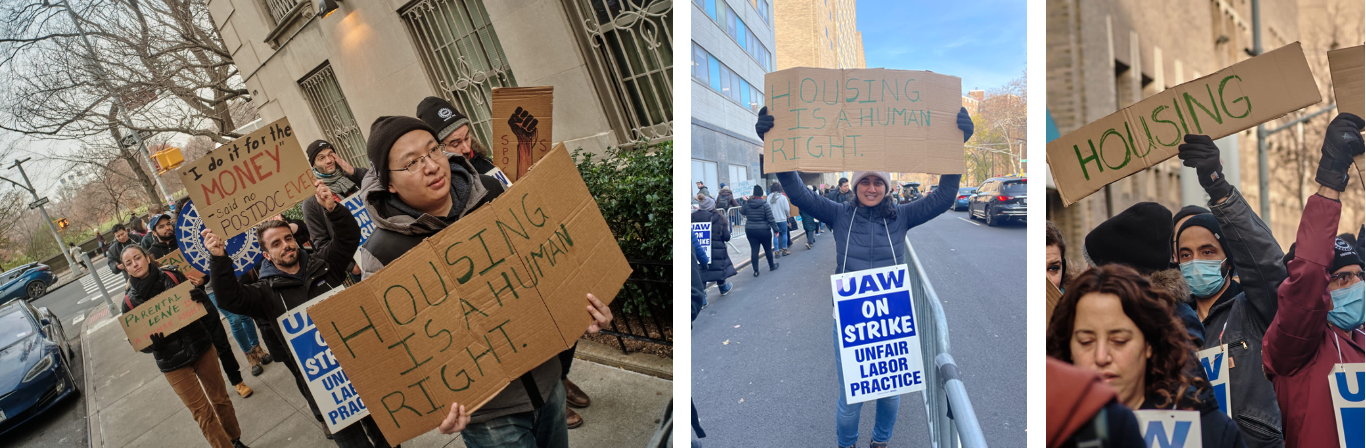
Access to affordable housing is a ticking clock for postdoctoral researchers at Mount Sinai. Most researchers relocate for postdoctoral positions, and at Mount Sinai, over 80% of postdoctoral researchers are international. Mount Sinai has historically offered subsidized housing for three years and granted three-month lease extensions on a case-by-case basis. Improving this benefit was a major factor why postdoctoral researchers voted to form our union, Sinai Postdoctoral Organizing Committee- United Auto Workers (SPOC-UAW), and a major focus of our 2022-2023 contract campaign.
After 14 months of bargaining and a 12-day strike, our union won the first housing rights for unionized postdoctoral researchers across the country. We won guaranteed housing for all incoming postdoctoral researchers, a one-month grace period for the payment of first month’s rent and security deposit, a 2% cap for annual rent increases, and more. However, extending the duration of housing remains a priority for postdoctoral researchers, and the current practice continues to be a three-year limit in Mount Sinai-owned housing.
Unfortunately, Mount Sinai is failing to maintain its past practice of granting housing extensions since contract ratification. These extensions used to provide flexibility to postdoctoral researchers who are already at a precarious phase in their career and family life: for example, a researcher who is starting a new job in a matter of weeks, or another who is adjusting to a newborn or their childrens’ school semesters. Now, all extension requests– even those for only one or two weeks– are being denied on the basis of low inventory and limited housing vacancies. This current situation is unsustainable and is especially harmful to women, postdoctoral researchers with families, and efforts to advance diversity and equity at Mount Sinai broadly.
To address these issues, postdoctoral researchers with SPOC-UAW conducted a supermajority-participation survey and canvassing campaign. We sought to understand occupancy and vacancy in Mount Sinai housing as well as postdoctoral researchers’ personal experiences with housing. Overall, we find an immediate need for all housing extension requests to be granted and ongoing needs for increased access to Mount Sinai housing and greater transparency on housing inventory.
Housing extensions are being denied at an unprecedented rate
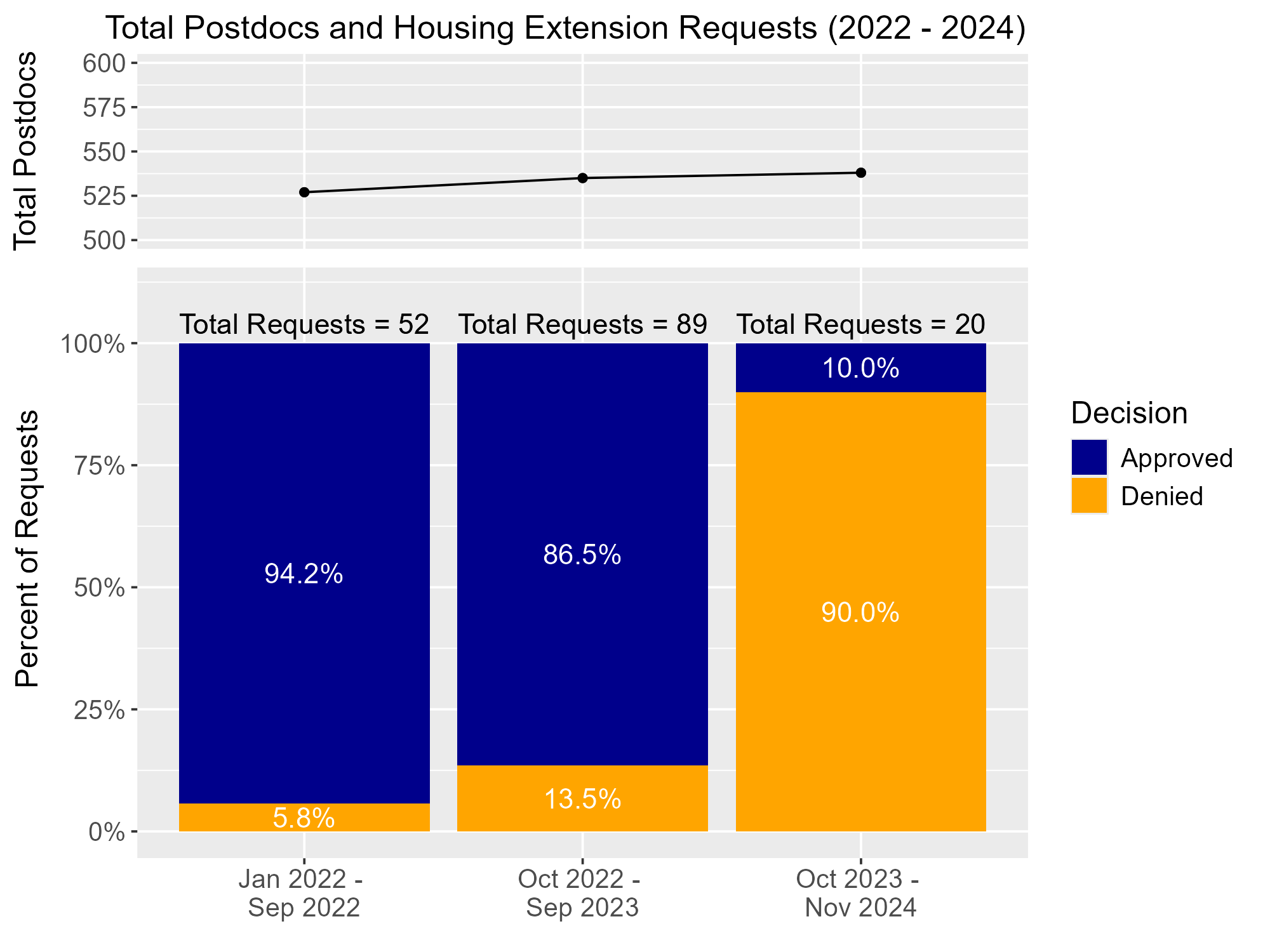
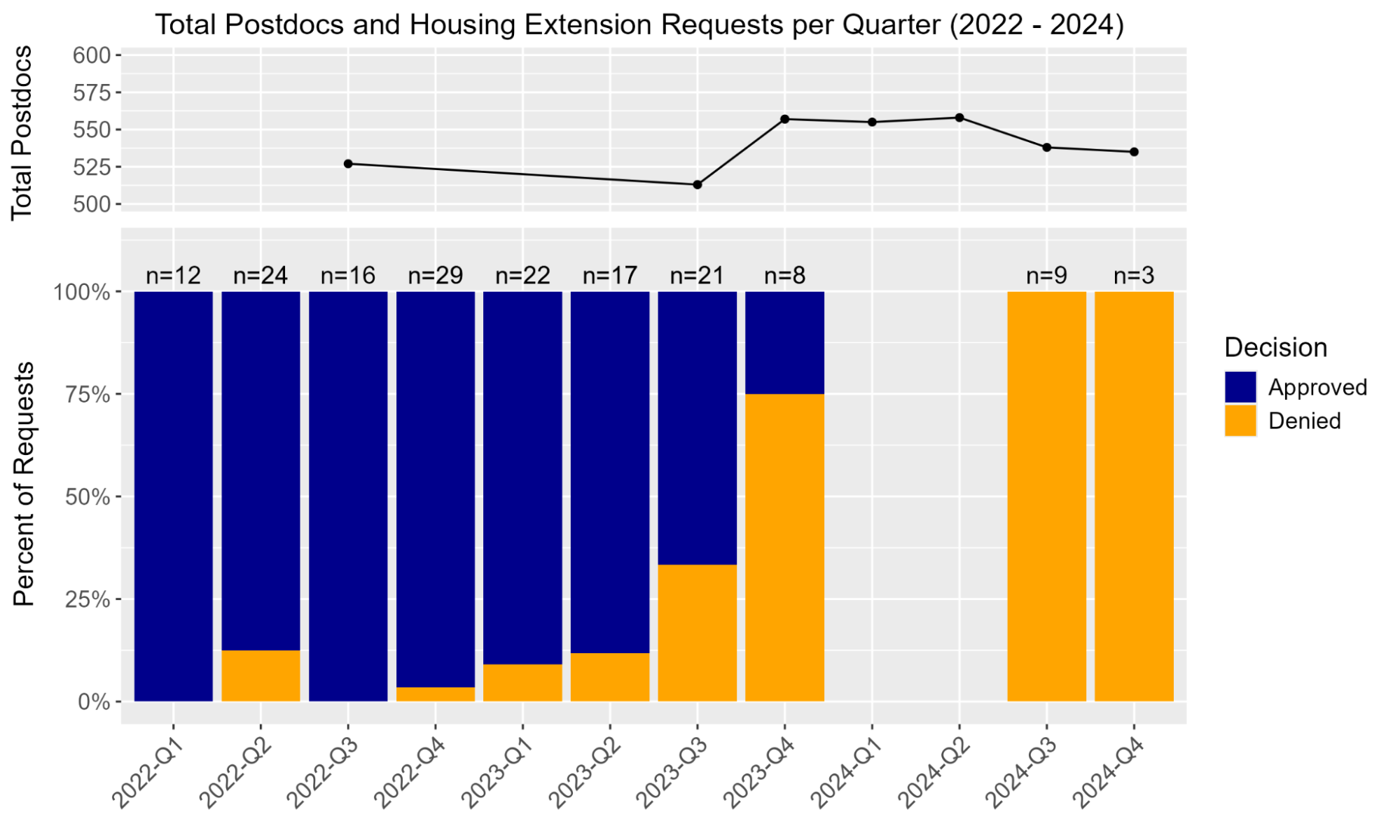
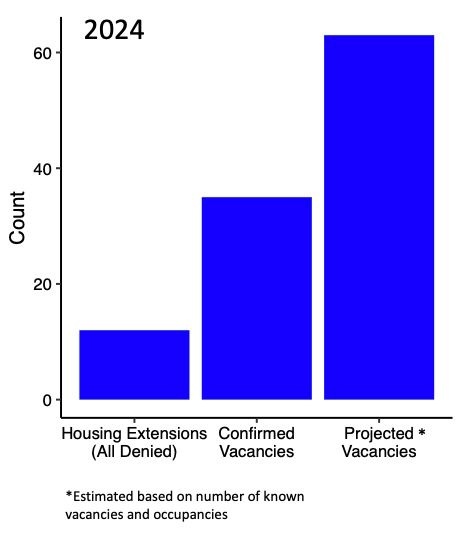
Negotiations on postdoctoral housing began to intensify in October 2023. Prior to this, postdoctoral housing extension requests were largely approved: 94.2% of requests were approved from January-September 2022 and 86.5% of requests were approved from October 2022-September 2023. In contrast, only 10% of requests have been approved since October 2023 and 0% since January 2024.
In three individual cases, SPOC-UAW filed grievances on behalf of postdoctoral researchers who had been denied housing extensions. The contract dispute centered on the interpretation of “current housing practices and subject to continued availability” (Article 12, Section 1), with the union’s position that denying extension requests is not consistent with Mount Sinai’s housing practices. In response, Mount Sinai claimed that housing availability had reduced significantly post-pandemic, partially due to a large number of incoming postdoctoral researchers since contract ratification. However, the total number of postdoctoral researchers has stayed relatively consistent (2-6%) since 2022.
Current housing vacancies exceed demand for housing extensions
In response to these challenges, postdoctoral researchers took action in two parallel campaigns related to Mount Sinai housing availability. First, we collected responses from a supermajority of postdoctoral researchers (488 out of 522, 93%) on a housing survey. Our primary goal was to begin a database of Mount Sinai housing occupancy based on addresses provided by respondents. Of approximately 330 known postdoctoral researchers in Mount Sinai housing, we collected survey responses including building and unit from 306 (93%) individuals. We also collected lease and rent information and engaged postdoctoral researchers in conversation about their experiences in Mount Sinai housing.
Second, postdoctoral researchers talked with their neighbors to gather information on occupancy/vacancy rates for Mount Sinai housing units. Postdoctoral researchers share these buildings with students, medical residents, superintendents, and non-Sinai affiliates. Of approximately 1126 known Mount Sinai housing units across 13 buildings, postdoctoral researchers knocked on 869 (77%) doors. Units were clearly identified as occupied (600) if a resident answered the door or vacant (35) if no one answered the door and neighbors or the super confirmed the empty apartment. For another 234 units, no one answered the door but vacancy could not be confirmed. A final 257 units were not knocked, mainly due to difficulties accessing the doorman buildings (306 E 96th St and 1245 Park Ave).
By projecting the 5.8% vacancy rate from the clearly identified units to the entire housing inventory, we estimate a minimum of 63 vacant units at Mount Sinai housing. The true number of vacancies is likely higher as knocked+unanswered doors are more likely to be vacant than average. Our crowdsourced data indicates sufficient housing availability to accommodate, at a minimum, the 13 extension requests from postdoctoral researchers this year.
Second, we engaged postdoctoral researchers in talking with their neighbors and determining occupancy/ vacancy for all Mount Sinai housing units. Postdoctoral researchers are a minority constituent of Mount Sinai housing; these buildings are shared with students, medical residents, superintendents, and non-Sinai affiliates. Of approximately 1126 known Mount Sinai housing units across 13 buildings, we knocked on 869 (77%) doors. Units were clearly identified as occupied (600) if a resident answered the door or vacant (35) if no one answered the door and neighbors or the super confirmed the empty apartment. For another 234 units, no one answered the door but vacancy could not be confirmed. A final 257 units were not knocked, mainly due to difficulties accessing the doorman buildings (306 E 96th St and 1245 Park Ave).
By projecting the 5.8% vacancy rate from the clearly identified units to the entire housing inventory, we estimate a minimum of 63 vacant units at Mount Sinai housing. The true number of vacancies is likely higher as knocked+unanswered doors are more likely to be vacant than average. Our crowdsourced data indicates sufficient housing availability to accommodate, at a minimum, the 13 extension requests from postdoctoral researchers this year.
Mount Sinai students and medical residents, and postdocs at peer institutions receive better housing benefits
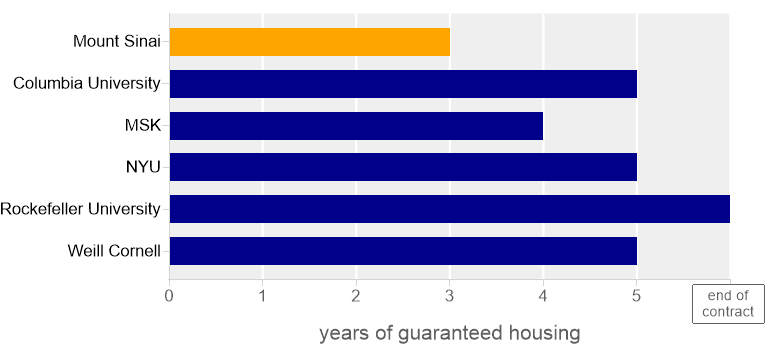
As postdoctoral researchers engaged their neighbors, we learned more about the housing benefits provided to Mount Sinai students and medical residents. Students (PhD and MD) have access to Mount Sinai housing for the duration of their training, ranging from 4 to over 8 years. Medical residents are similarly offered housing for the duration of their residency (3-7 years). The majority of postdoctoral researchers occupied the E 97th St buildings, which have many issues– cockroaches, mice, poor insulation to street and subway noise, old and noisy heating systems– that disproportionately affect postdoctoral housing constituents. Greater transparency in occupied and vacant apartments, as SPOC-UAW has now attempted to crowdsource, would help postdoctoral researchers interested in transferring units.
Mount Sinai’s three-year postdoctoral housing benefit also lags behind that of other, peer institutions in the city. At Memorial Sloan Kettering, postdoctoral researchers have access to subsidized housing on Roosevelt Island for four years. New York University postdoctoral researchers can apply for five years of subsidized housing. Rockefeller University postdoctoral researchers are guaranteed housing for the duration of their employment. Weill Cornell Medicine postdoctoral researchers can stay in postdoctoral housing for five years; while housing is not guaranteed, incoming postdoctoral researchers have priority access. Columbia University has a housing lottery that also allows postdoctoral researchers up to five years in subsidized housing. As postdoctoral researchers at the latter three institutions are unionized, we expect that housing rights and protections will only strengthen and improve working conditions for all postdoctoral researchers in the city.
Conclusion and Vision
Postdoctoral researchers drive Mount Sinai’s half-billion-dollar-a-year research enterprise by conducting experiments, writing grants and papers, and mentoring lab staff, but we are vulnerable to low pay, high workload, job instability, bullying and harassment, and other unfair working conditions. Through unionization and negotiation for our first contract, we are proud to make Mount Sinai the first institution to guarantee postdoctoral researchers access to subsidized housing and a more inclusive, equitable, and accessible place to work.
We now call on Mount Sinai to increase its commitment to postdoctoral researchers by extending our eligibility for subsidized housing to the duration of our appointments. Urgently, Mount Sinai must approve housing extension requests from postdoctoral researchers. Our data indicates that Mount Sinai has sufficient availability to meet these requests. We urge Mount Sinai to provide greater transparency on housing inventory so that postdoctoral researchers can better understand housing constraints and opportunities. Together with unionized postdoctoral researchers across the city and our neighbors in the broader community, we look forward to continuing our fight for affordable housing for all working class New Yorkers.